
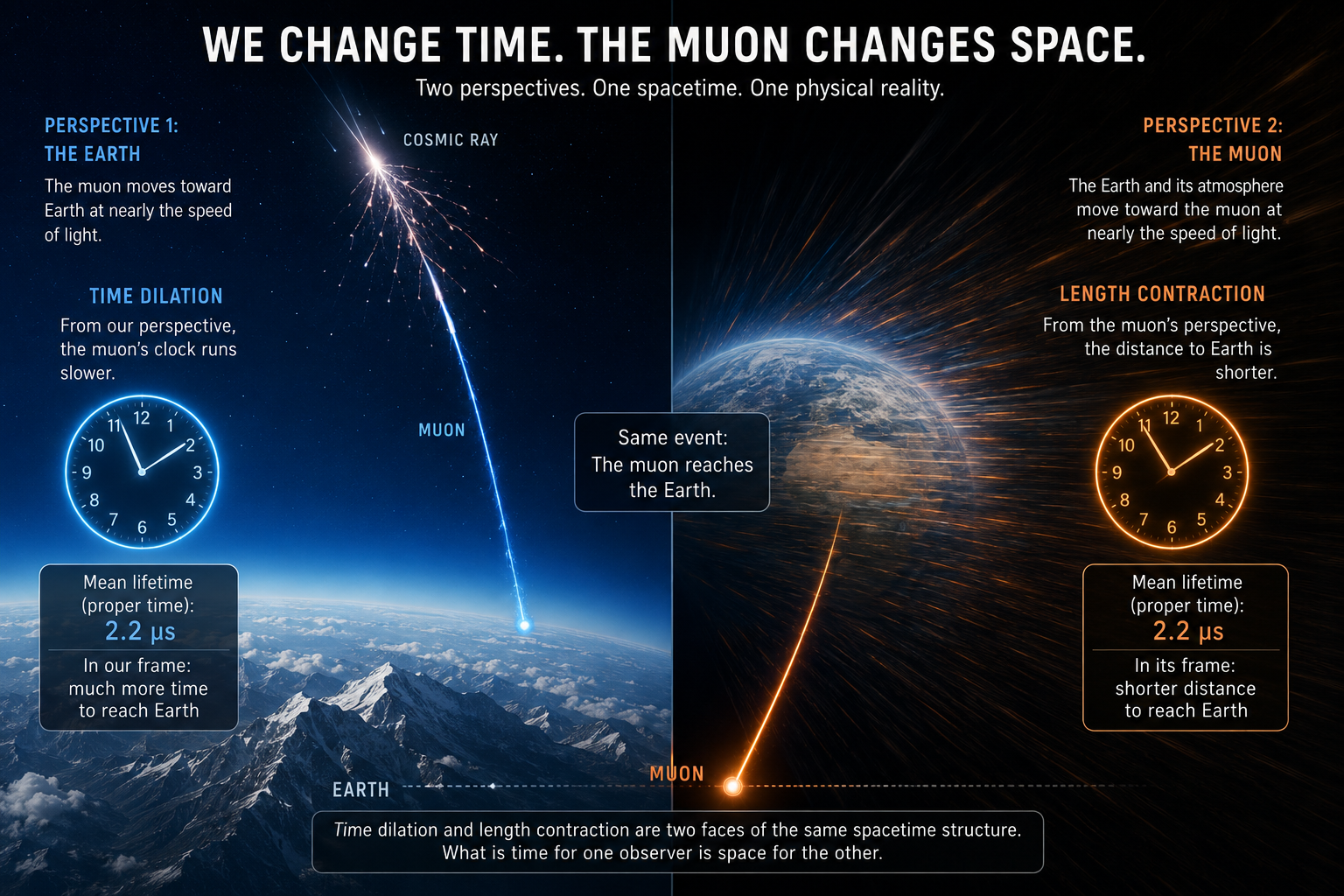
We Change Time. The Muon Changes Space.
How two observers can describe the same journey completely differently – and both be right
In my first essay about Newton and Einstein, I jokingly described Einstein as a kind of alien. Not because his physics is wrong or mystical – quite the opposite. But because the world Einstein describes fundamentally contradicts our human intuition.
The following example perhaps shows better than any other why.
Space, Time and the Limit of the Speed of Light
Two Clocks, One Reference Frame
Special relativity does not treat space and time as two independent, absolute quantities. Together, they form spacetime.
Imagine two clocks at rest relative to each other. Both run at the same rate. As long as they remain at rest relative to one another, there is no time dilation caused by relative motion – neither clock runs faster or slower than the other.
Only when one clock begins to move relative to the other does a difference emerge: from the perspective of the stationary observer, the moving clock runs more slowly. The higher its velocity, the stronger this effect becomes.
Changing Perspective
Now we change sides and look at the same situation from the reference frame of the moving object.
For the object itself, its own clock runs perfectly normally – after all, it is at rest in its own reference frame. Instead, the original reference frame is now moving relative to it.
A distance that is at rest in the original reference frame and lies parallel to the direction of motion is measured as shorter from this new perspective. The higher the relative velocity, the stronger this length contraction becomes.
This reveals two sides of the same relativistic relationship: from the original reference frame, the measured time of the moving object changes. From the object’s own reference frame, the measured length of a distance moving relative to it changes.
Time dilation and length contraction therefore do not describe two different physical realities. They are two consequences of the same structure of space and time – viewed from different reference frames.
The Absolute Limit
For objects with mass, there is a hard limit: their velocity can approach the speed of light c as closely as desired, but can never reach or exceed it. It always remains v<c. Accelerating an object with mass to the speed of light would require an infinite amount of energy.
The closer an object with mass comes to the speed of light, the shorter a distance between start and destination, fixed in the original reference frame, becomes for the moving object, and the less time passes on its own clock during the journey. In the mathematical limit v→c, both quantities approach zero.
At c itself, however, this way of looking at the situation ends – the traveller’s perspective can no longer be continued.
The Photon: A Limit Without an Observer
Photons have no rest mass and travel through a vacuum at the speed of light. Between the emission and absorption of a photon lies a lightlike spacetime interval. The proper time along this worldline is zero – regardless of whether the photon travels one metre or billions of light-years in our reference frame.
A photon, however, has no rest frame. Every observer moving at constant velocity – an inertial observer – measures the same speed c for light in a vacuum. There is therefore no observer who could move in such a way that the photon would be stationary relative to them.
We can therefore correctly say: Along the worldline of a photon, no proper time elapses between emission and absorption.
But we cannot say that „from the photon’s perspective“ no time passes, or that the photon itself measures a distance of zero. Such a statement would require a reference frame of the photon – and no such reference frame exists.
Special relativity therefore takes us to a remarkable boundary: an object with mass can approach the speed of light arbitrarily closely. In doing so, the distance measured by the moving object and the travel time elapsed on its own clock become smaller and smaller. In the limit, both approach zero.
But precisely at that boundary, our ability to continue the traveller’s perspective ends.
The Muon – Two Perspectives, One Reality
A Particle That Should Not Reach the Earth According to Classical Reasoning
What has so far sounded theoretical can be observed in a particle that is constantly being created in the Earth’s atmosphere: the muon.
Muons are produced several kilometres above the Earth through interactions between cosmic radiation and the atmosphere. They are unstable and have a mean lifetime of only about 2.2 microseconds in their own rest frame.
At first, this creates a problem.
During a travel time of 2.2 microseconds, even light would cover only about 660 metres. A muon travels more slowly than light and would therefore cover even less distance. Yet many muons are created several kilometres above the Earth – and large numbers of them still reach the surface.
How is that possible?
Perspective One: The Earth
From our reference frame on Earth, the atmosphere is several kilometres thick, and the muon is travelling towards the Earth at almost the speed of light.
This is where time dilation comes into play.
From our perspective, the muon’s clock runs more slowly. Its mean proper lifetime of 2.2 microseconds corresponds to a substantially longer period in our reference frame – long enough for many muons to travel the distance to the Earth’s surface.
We explain their arrival through a change in time.
Perspective Two: The Muon
Now we look at exactly the same process from the muon’s rest frame.
For the muon, nothing unusual happens to its own time. Its clock runs normally, and its mean lifetime remains about 2.2 microseconds.
But now the Earth, together with its atmosphere, is moving towards the muon at almost the speed of light.
This is where length contraction comes into play.
The distance between the muon’s point of origin and the Earth’s surface is measured as substantially shorter in the muon’s reference frame – short enough for many muons to reach the Earth’s surface within their normal lifetime.
The muon explains its arrival through a change in space.
Two Explanations, One Event
We change time. The muon changes space.
Of course, neither we nor the muon actively change anything. The sentence is deliberately simplified to capture what makes special relativity so difficult to imagine.
Both observers are looking at the same physical process and reach the same conclusion: the muon can reach the Earth’s surface.
But their descriptions are fundamentally different.
For us, less time passes on the muon’s moving clock.
For the muon, the distance to Earth is shorter.
Time dilation and length contraction are therefore not two independent tricks of relativity. They are two consequences of the same spacetime structure.
What appears to one observer as a change in time appears to the other as a change in space.
Two perspectives. One spacetime. One physical reality.
Perhaps that is exactly why Einstein still seems so alien to us more than a hundred years later.
Our perception separates space and time.
Nature does not.