
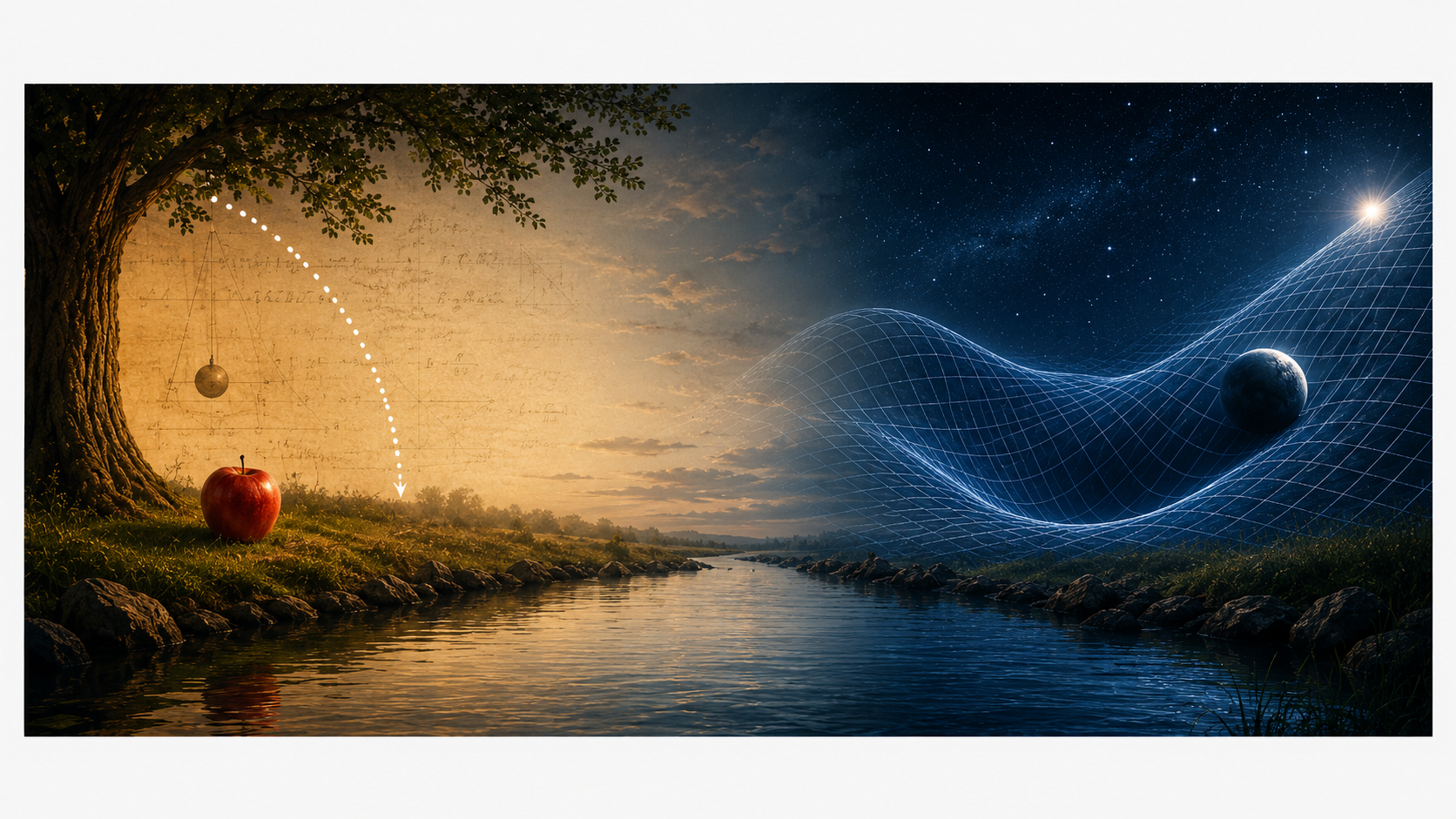
Newton Was One of Us. Einstein Was an Alien.
Why Newton still feels intuitive, why Einstein does not, and what systems theory reveals about the limits of human perception.
A Systems-Theory Perspective on Physics
The title is deliberately provocative. But it describes a feeling that has accompanied me for decades—as an engineer who has spent his professional life designing machine controls, feedback systems, and industrial automation.
Newton was one of us. His physics matches our everyday experience. Space and time are constant. Cause and effect are unambiguous. For an engineer, this is the world of machines, production systems, and control loops—a world where every fault has a cause and every system can ultimately be understood.
Then came Einstein. Suddenly, time became relative. Space could bend. Simultaneity lost its absolute meaning. Physics continued to work—better than ever—but it moved away from human intuition.
That is no coincidence, nor is it a limitation of our intelligence. Ethologist Konrad Lorenz described the domain for which human perception evolved as the mesocosm: meters, seconds, kilograms, and the speed of prey.
Neither the extremely fast, the extremely massive, nor the extremely small shaped the evolutionary pressures faced by our ancestors. In the language of systems theory, we were optimized for a particular operating window—not for the boundary conditions of nature.
Does that mean Einstein is irrelevant to our daily lives?
On the surface, for 99 percent of humanity, yes. Nobody experiences time dilation in everyday life. Yet its consequences are deeply embedded in our infrastructure—hidden, much like a fault whose root cause lies outside the system being observed.
Back in history
This reminds me of my internship 1978 at the German Radio Monitoring Service. An elderly lady suffered from seemingly random interference on her television. Because the disturbance occurred only sporadically and appeared completely unrelated to any obvious switching event, it took us weeks to identify the cause.
Everyone initially searched for the fault inside the TV set. The real cause, however, was outside the system: a defective fluorescent lamp starter in her refrigerator generated electromagnetic pulses that disrupted the television.
The observed problem was inside the system. The actual cause was not.
Exactly the same principle applies to GPS. Without daily corrections based on Special and General Relativity, every navigation system on Earth would drift by roughly ten kilometers per day. Relativity is not an exotic curiosity of theoretical physics—it is an invisible cause that keeps one of humanity’s largest distributed systems functioning reliably.
Anyone with a background in industrial automation immediately recognizes the pattern, although without relativity. Distributed control systems also suffer from diverging local time bases due to oscillator tolerances, aging, and thermal drift.
The solution is called synchronization. From a systems-theory perspective, it serves exactly the same structural function as the relativistic corrections applied in GPS.
The underlying mechanism is remarkably similar in both cases. The problem is not a measurement error that disappears with faster sampling. It is a continuous offset between independently running clocks that must be compensated permanently.
👉In GPS, the underlying cause is different proper times resulting from gravity and orbital velocity.
👉In industrial systems, it is oscillator drift and hardware tolerances. The physical causes are entirely different—but the systems pattern is strikingly similar.
To me, offset correction appears to be a fundamental principle of distributed systems.
But my real point goes beyond GPS.
Let us move one level deeper—to quantum mechanics.
The Schrödinger equation describes the evolution of a quantum state in a precise and deterministic way. The real mystery begins when one specific measurement outcome suddenly emerges from several possible ones.
The double-slit experiment illustrates this remarkably well. Individual particles gradually build up an interference pattern, even though each particle is detected only once.
Without any external influence or visible mechanism controlling the process, the individual detection events appear as if they were somehow „orchestrated“.
We can clearly observe the pattern, but not the mechanism that places each individual event exactly where it contributes to the final result.
Quantum entanglement makes the puzzle even more profound. In 1964, John Bell showed that the observed correlations cannot simply be explained by particles carrying locally stored, predetermined properties.
Decades of experiments confirmed this prediction. An entire class of intuitive, mechanical explanations has therefore been ruled out.
We can predict the results with extraordinary accuracy. But whether quantum mechanics already describes the underlying cause—or merely the observable behavior within its own system boundaries—remains an open question.
And this is where, for me as an engineer, the truly interesting question begins.
Every system has boundaries. Within those boundaries, certain rules apply. Beyond them, entirely different mechanisms may exist.
Whether quantum mechanics already describes the underlying causes—or merely the observable effects within our accessible system—is something no one can claim to know with certainty.
Perhaps this resembles the old story of the blind men and the elephant. Each person correctly describes the part they can touch. Yet none of them understands the whole animal.
👉Newton described one part.
👉Einstein described a larger one.
👉Quantum physics describes another.
All three frameworks are extraordinarily successful—and yet they still do not fit together. Newtonian mechanics was not proven wrong; it turned out to be a special case of a more comprehensive theory. Why should we assume today’s physics is immune to the same possibility?
This is not a criticism of modern physics. Its predictive power is extraordinary, and that is beyond dispute. But history repeatedly teaches us that successful models are not necessarily complete models.
That is precisely why serious discussion does not need careless simplifications, fashionable buzzwords, or click-driven exaggeration. Complex questions are not made clearer by turning them into spectacle. They require precision, intellectual discipline, and the willingness to distinguish established knowledge from interpretation and speculation.
Forty years of working with technical systems have taught me one simple lesson:
Always identify the boundaries of a system before trying to understand the rules that operate within it.
Perhaps that is also the most fundamental question in modern physics:
Are we already touching the entire elephant—or still only the part that fits inside our mesocosm?